


Bestu Varas Outfits 2026: Gujarati New Year Sarees & Suits

Quick answer: For Bestu Varas, the Gujarati New Year, choose a saree or suit that feels polished during morning greetings and remains comfortable for temple visits, family meals and evening get-togethers. Printed georgette and pre-stitched sarees can be convenient for a busy schedule; organza, tissue, woven-look sarees and embroidered suits provide other visual directions. There is no compulsory outfit colour or single correct silhouette. Start with your celebration plans, personal comfort and the actual product details rather than buying a garment solely because it is labelled festive.
When is Bestu Varas in 2026? The Drik Panchang 2026 Gujarati New Year calendar lists Tuesday, 10 November 2026, for the start of Gujarati Vikram Samvat 2083. Gujarati New Year follows the Diwali period and is also called Bestu Varsh or Nutan Varsh. Regional family practices vary, so check your local calendar for any associated puja arrangements. This guide addresses clothing for that specific day, not another general Diwali outfit roundup.
The day may involve early greetings, receiving relatives, visiting an elder’s home, attending a gathering or taking family photographs. That makes the buying problem different from planning a one-hour evening party. A garment can photograph beautifully yet become awkward if you spend hours sitting, moving between houses or helping serve a meal. A practical New Year outfit should be as pleasant to wear at the end of the day as it is when you first get dressed.
Browse ClothsVilla sarees, ready-to-wear sarees and salwar suits alongside the ten individually linked product examples below. These products were marked active, published to the online store and available for sale in Shopify when selected; most do not track inventory, so availability is not a verified count of physical stock. Product pages remain the source for current variants and order information.
A New Year outfit begins with your actual schedule
If your first stop is a quiet family prayer, your priorities may be coverage, easy movement and a secure pallu rather than maximum shine. If you are hosting, think about how the clothing behaves while bending, reaching for dishes and sitting on different chairs. If you are visiting several households, the key questions are whether the fabric creases, whether you can manage your footwear at doorways and whether you need to readjust the drape repeatedly. An evening gathering might allow more decorative work, but that does not automatically mean you need a second garment.
Write a two-line schedule before shopping: where you will go, and how long you will spend there. Then choose one outfit that suits most activities rather than purchasing a different look for each stop. The emphasis here is versatility across the day. Our existing Diwali puja morning outfit guide focuses on a different festival moment; use it as a complementary reference for earlier celebrations, not a replacement for Bestu Varas planning.
Ten live ClothsVilla looks to consider
These examples deliberately span understated prints, more structured sarees, a pre-stitched option and two suits. The product image in every section links to the exact listing it represents. They are illustrations of styling choices, not a promise that any particular fabric or colour carries a religious requirement. Check stitching, blouse pieces, measurements and colour options on the individual live pages before ordering.
1. Navy blue organza-silk saree for a structured festive look
The Navy Blue Organza Silk Saree offers a dark, refined colour direction when you want an alternative to traditional reds. Its listing identifies organza silk. Organza tends to hold more shape than a fluid drape, so the way you pleat and secure the pallu matters. If you intend to sit through a long meal, practise arranging the pallu without letting it pull tightly across your shoulder. Keep jewellery restrained if the garment already has visible detailing.

For a family visit, a small handbag and footwear you can remove and put on easily may be more helpful than an elaborate outfit accessory. If your celebration continues after sunset, navy offers a deep base for warm jewellery tones, but the right choice still depends on the actual finish visible on the product page.
2. Firozi printed georgette saree for a lighter visual direction
The Firozi Printed Georgette Saree is described as georgette with printed detailing and a pearl-lace border. That contrast between print and decorative border can add interest without requiring a complex jewellery set. A firozi shade also provides a distinct palette from navy, maroon and pink. If you are new to a draped saree, focus on the petticoat fit and pleats, not just the fabric’s appearance in photographs.

Because decorative borders can catch on sharp jewellery or a bag strap, check where the lace falls when the pallu is draped. One well-fitting earring style is often enough near the face. If you are coordinating with family, firozi can sit beside cream, deep blue and muted gold without asking anyone to match it exactly.
3. Dark pink organza-silk saree for a celebratory palette
The Dark Pink Organza Silk Saree supplies a brighter colour option for New Year greetings and group photographs. Its listing calls the fabric organza silk and indicates a blouse piece in the title. Do not assume that a blouse piece is stitched: check the actual product details and allow tailoring time where needed. Pair the outfit with jewellery that follows the surface finish rather than automatically adding more colour everywhere.

Use natural daylight to assess colour when possible, then check a warm indoor-light photograph if you are planning an evening gathering. Phone displays can make dark pink look warmer or cooler than it is. If colour matching is important for a family photograph, aim for complementary shades rather than expecting two separately ordered garments to be identical.
4. Ivory-white satin-silk printed saree for a quiet morning style
The Ivory White Satin Silk Digital Printed Saree is a lighter-looking option for someone drawn to pale neutrals. The product’s description identifies satin silk and digital print. A light-coloured saree is not automatically better for any ritual; it is simply a styling preference. If you will be serving food or travelling between homes, consider where the pallu sits and how you will protect pale fabric from spills.

If a plain bag and light footwear already live in your wardrobe, reusing them may be more practical than buying everything new. A neutral look becomes distinctive through the actual pattern, a carefully arranged pallu and one accessory you enjoy wearing. Avoid vague assurances that pale fabric is stain resistant or easy to wash; the care instructions, not its colour, determine how it should be treated.
5. Teal-green one-minute saree for a packed visiting schedule
The Teal Green Ready-to-Wear One Minute Saree is identified in the catalogue as pre-stitched and made with a satin-silk or blended-silk description. A ready-to-wear format may reduce pleating time if the actual construction suits you, but it is not automatically adjustable to every size or body proportion. Check waist and hip requirements and the position of its fixed pleats before choosing it for a long New Year day.
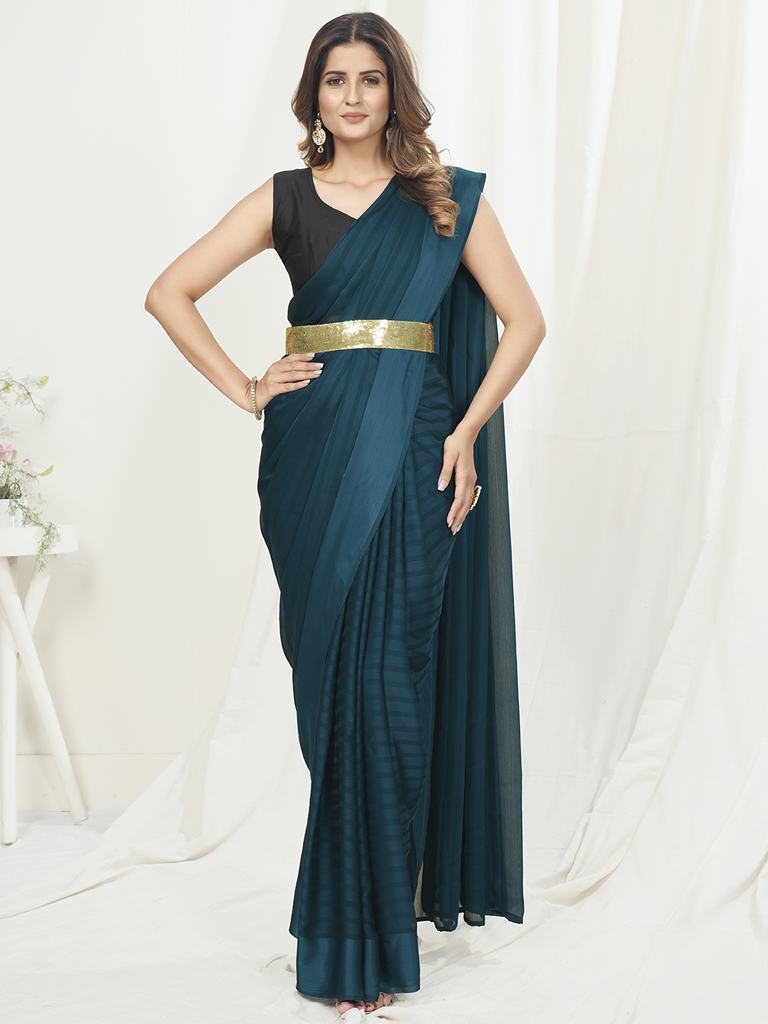
Try sitting down, walking and raising your arms during the final fitting. A fixed drape that feels easy while standing can still need an adjustment at the waist or pallu. Our saree petticoat and shapewear guide covers fit considerations for traditional drapes; follow the ready-to-wear product’s own construction instructions where those differ.
6. Sky blue tissue-shimmer saree for a more luminous finish
The Sky Blue Tissue Shimmer Saree lists zari weaving and a sequin-lace border. This offers a visible contrast to the printed and calmer garments above. For an evening New Year dinner, its surface detail may be enough to carry the look; for daytime, keep accessories simpler if you prefer less shine. Do not assume the piece is a particular fibre blend simply because the listing uses the word tissue.

If the border feels substantial, arrange it so it does not drag on the floor or pull heavily at one shoulder. A delicate or open-weave surface should be tested with pins carefully, using the saree’s own care guidance. No outfit looks polished when you are constantly rescuing a loose pallu, so make a few practice movements before leaving.
7. Royal blue Paithani-style jacquard saree for a woven appearance
The Royal Blue Paithani Silk Saree with Jacquard Weaving is described with a Paithani-silk designation and jacquard weaving. Use the specific listed fabric and weave descriptions without assuming geographical origin, handloom certification or fibre purity from the product title alone. Its royal blue palette gives a traditional-looking alternative to brighter printed options and can be styled with a simple blouse cut if the saree itself is visually detailed.

For a family portrait, royal blue can be coordinated with lighter blue, ivory or restrained gold accents. Keep the group visually connected through tone rather than requiring matching embroidery. The existing family photo outfit guide explains that broader coordination approach; Bestu Varas gives you a separate reason to apply it.
8. Maroon Banarasi-style saree for a deeper celebratory colour
The Maroon Banarasi Silk Saree provides a dark red-family palette for those who want a more traditional-looking festive outfit. The listing uses the designation Banarasi silk and mentions a blouse piece. It does not follow that you can infer a particular weaving centre or that the blouse is ready to wear without checking the full description. For long family visits, a well-fitting blouse and balanced petticoat matter more than an elaborate drape tutorial you have not practised.

Maroon pairs naturally with the metal tone already visible in the border or woven design, but accessories need not be bought as a set. If the blouse neckline is ornate, consider earrings rather than adding a heavy necklace that hides it. Do not choose earrings that are uncomfortable during greetings, travel or long conversations.
9. Baby-pink Farshi shalwar set as a non-saree choice
The Baby Pink Glass Farshi Shalwar Set is described in the catalogue as a ready-to-wear Farshi set using Glass Roman Silk with embroidery and decorative detailing. A Farshi-style bottom has a different visual proportion from a narrow pant, so pay attention to its overall length and how the fabric gathers around your feet. A suit can be more convenient than a saree for some people, but generous bottoms still need a safe walking length.

Before styling, read the listing’s exact package contents so you know what comes with the top, bottom and dupatta. A narrower necklace or a pair of light earrings may be more comfortable if the neckline already has decorative work. If the event includes floor seating, sit in the full outfit once to confirm that the bottom gathers comfortably and the dupatta stays controlled.
10. Olive-green pant-style suit for an understated alternative
The Olive Green Pant Style Suit with Zari & Sequins is described as a georgette-silk-blend pant-style suit with zari and sequin detailing and a matching dupatta. This is a useful option when a three-piece outfit is more appealing than a saree but you still want a dressed-up appearance. The colour feels quieter than many jewel tones, while the stated surface work can provide its festive note.

For house visits, the most useful test is whether the pant hem stays clear when walking and the dupatta remains secure when you bend. If there is a decorative cuff or border, avoid accessories that snag it. A simple neutral bag can work across multiple family events, helping this outfit remain versatile beyond one festival.
Quick comparison: choose by occasion rather than a colour rule
| New Year plan | Outfit direction | Most useful check |
|---|---|---|
| Morning greetings and puja | Ivory printed saree, Firozi printed saree or olive pant suit | Coverage, pallu or dupatta security |
| Visiting several homes | Teal pre-stitched saree or a correctly fitting suit | Waist, hem and walking comfort |
| Family photograph | Dark pink organza, royal blue jacquard or maroon saree | Colour and detail under real light |
| Evening meal or gathering | Navy organza or sky blue tissue-shimmer saree | Seated comfort and accessory balance |
| Prefer not to drape a saree | Baby-pink Farshi set or olive pant-style suit | Exact finished garment measurements |
These are styling directions, not an evaluative ranking or an assertion that any garment is restricted to a particular time of day. The right outfit is the one that fits your plans and your own preferences. A pre-stitched saree might be ideal for a busy day but unsuitable if its fixed waist does not fit; an organza saree might look structured but need more deliberate pinning. Let the individual listing, not a generic trend claim, settle the choice.
What colours should you wear for Gujarati New Year?
There is no single colour that everyone must wear. Maroon, pink, blue, green, ivory and softer neutrals can all look appropriate depending on family custom, location and personal taste. When several relatives want coordinated photographs, select a shared colour family or jewellery tone instead of making everyone buy identical garments. For example, navy and firozi can sit together as cool blues, while maroon and dark pink can share a warm accent. Olive and ivory are quieter companions if you prefer contrast.
Consider your home’s lighting rather than treating online photos as an exact colour reference. An outfit photographed under strong studio lighting may look different in a courtyard or warm indoor room. Examine all available product photos, look for the same colour across images and ask the seller when shade accuracy is critical. Never infer that a colour name proves an exact Pantone or fabric-dye match.
Blouse preparation makes or breaks a saree outfit
The most common New Year preparation mistake is selecting a beautiful saree but forgetting whether its blouse material is stitched. Check the package contents for every saree. If you need tailoring, book early enough for at least one adjustment. Make sure the shoulder does not slip while you greet relatives, the armhole allows comfortable movement and the closure does not pull while seated. A well-shaped blouse makes a simple pallu look deliberate without requiring elaborate jewellery.
If you plan a high neckline, reconsider heavy necklaces that sit over the seam. A lower neckline may work with different jewellery, but personal coverage preferences matter more than a trend photograph. Check our existing saree pinning guide for securing pleats and protecting delicate fabric. A pin should not be forced through pearl lace, sequin work or a fragile weave simply because it holds another saree securely.
Dupatta and pallu decisions for hosting or travelling
If you are hosting, keep the loose end of your saree or dupatta away from serving surfaces and cooking areas. That is a practical safety consideration, not a suggestion that all fabrics behave alike. If you are travelling, practise entering and leaving a vehicle while keeping the hem and pallu clear. For a suit, do not add an extra dupatta unless the product actually includes one or you intend to buy it separately. A product photograph may show styling accessories that are not listed in the package.
For traditional sarees, an open pallu shows more of the design but may need more attention as you move between homes. Pleating the pallu can keep fabric more contained if it suits the saree construction. For pre-stitched sarees, follow the fixed drape and fit guidance rather than trying to force a conventional pleat arrangement. If your fabric is particularly textured or delicate, check the care label before ironing or steaming.
Jewellery, footwear and beauty: finish the look without extra spending
Let the garment’s visible work determine accessory intensity. A tissue-shimmer saree with sequins or an embroidered Farshi suit may need just one jewellery focus. A quieter printed saree might suit earrings with a little more presence if they are comfortable. Jewellery does not have to be expensive or new to look considered; a familiar pair that you can wear all day is usually easier to manage than heavy pieces you are trying for the first time.
Choose footwear that works for your actual route, including steps, homes where shoes are removed and possibly uneven outdoor ground. Wear the intended shoes while checking saree length or the fall of a Farshi bottom. A little makeup that holds comfortably through greetings and meals is more practical than a new routine you have not tested. Keep a small pouch with essentials you already use rather than buying an elaborate festival-only kit.
Budget and buying checks before you place the order
First decide whether your budget covers only the garment or must also include shipping, blouse stitching, alteration and accessories. A pre-stitched saree may reduce draping effort but should never be treated as one size fits everyone; a traditional saree with an unstitched blouse may require additional tailoring. Compare the final cost of the whole outfit rather than the product’s headline price. Review the store’s current checkout and exchange terms instead of assuming the conditions are identical to an earlier purchase.
Use the same product-page checklist for all ten: confirm availability for your chosen variant, read its fabric wording exactly, check whether it tracks inventory, inspect the blouse or dupatta inclusion, record any size or length details and identify potential tailoring time. Our festive fabric comparison guide discusses general fabric behaviour, but it cannot replace the specific listing’s composition and care instructions.
Wear it again after Nutan Varsh
A New Year outfit can become part of your wardrobe rather than a single-use costume. A navy or maroon saree may suit another family function; a printed georgette saree can be restyled with familiar jewellery; a fitted suit can be worn for a different celebration. Rewear is easiest when you avoid buying accessories that only work with one exact colour. Keep the garment clean and stored according to its care guidance so decorative borders and embroidery remain protected.
If you intend to wear the same piece for Diwali and then Bestu Varas, inspect it between events and plan enough time for any cleaning or simple repairs. You do not need an entirely new outfit merely because the celebration has a different name. The distinctive planning challenge is moving from Diwali festivities into a day of New Year greetings with clothing that still feels special and comfortable.
Frequently asked questions
When is Bestu Varas in 2026?
Drik Panchang lists Tuesday, 10 November 2026, for Gujarati New Year and the start of Vikram Samvat 2083. Check a local panchang for your family’s observances.
What should women wear for Gujarati New Year?
A saree, salwar suit, Farshi set or another respectful outfit you enjoy wearing can work. Match the silhouette to your schedule, fit and family preferences rather than following a supposed compulsory colour.
Is a pre-stitched saree suitable for Bestu Varas?
Yes, if its fixed waist, pleats and length fit correctly. Read the live variant information and try sitting and walking in it before the occasion.
Which saree fabric is convenient for visiting relatives?
There is no universal winner. A fluid printed saree may be easier for some people to arrange, while others prefer a structured fabric. Check the actual garment’s weight, care needs and the drape you are comfortable wearing.
Do I need to wear red or yellow on Gujarati New Year?
No universal dress-colour rule applies to every family. Follow your own traditions if you have them, or choose a festive colour that you like and can comfortably wear.
Are the featured ClothsVilla products physically in stock?
The linked products were active, online-store published and Shopify marked the selected variants available for sale when checked. Most do not track inventory, so a physical warehouse quantity was not independently verified; check the current listing before purchase.
How early should I order an unstitched blouse saree?
Leave enough time for shipping, tailoring, a fitting and possible changes. Read the product’s actual stitching information before relying on it for an event date.
A New Year wardrobe that fits your life
Bestu Varas is an opportunity to enjoy familiar textiles and personal style while celebrating a new beginning with family and friends. Start with the day you will actually have, choose a saree or suit whose details you can verify, and test the full outfit before the first greeting. The ten photographs above are each linked to a currently saleable ClothsVilla listing, and the Traditional Wear collection provides further browsing. Choose a look you can move in, look after and enjoy again—rather than collecting accessories or garments that only make sense in one photograph.